
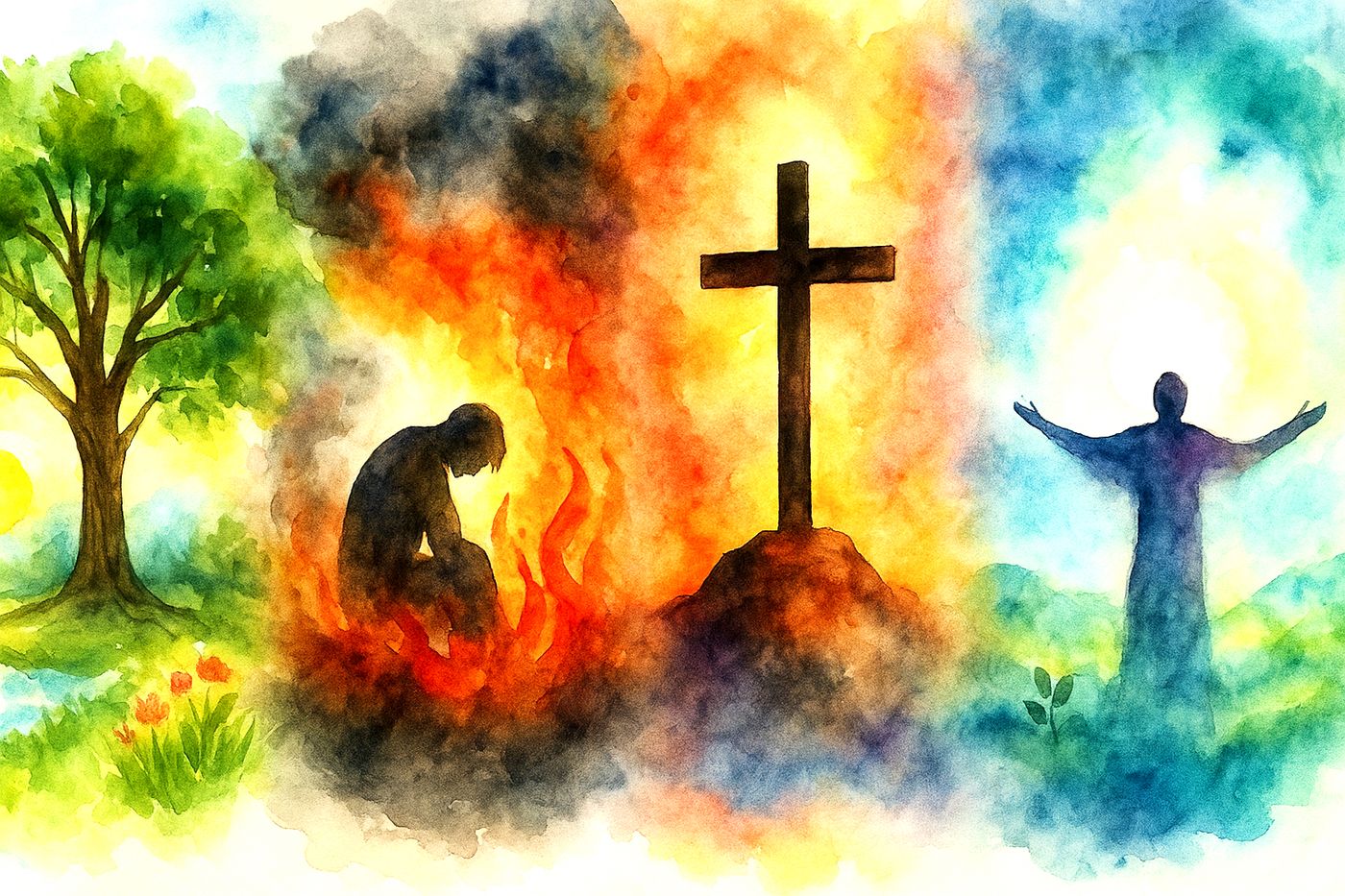
There’s been something stirring in my heart lately as I talk with people about Jesus.
In these conversations—some deep, some emotional, some unexpected—I’ve noticed how easy it is to drift away from the center of the gospel and get tangled up in the details orbiting around it.
Those details matter. They are biblical. They help us understand God more fully.
But if we don’t keep the main point in view, we can confuse the person we’re talking to, frustrate them, or overwhelm them in a moment when they just needed Christ.
One conversation recently made me aware of this. I won’t mention names, because it’s not about who—it’s about how easy it is to lose clarity when our heart wants to help someone see truth.
I walked away asking the Lord to make me clearer, simpler, more centered on Christ—and to help me guide others the same way.
So today, I want us to slow down and re-learn the gospel the way Scripture tells it:
Creation → Fall → Redemption → Restoration.
This structure has clarity.
It has weight.
It has the right emotional and theological flow.
CREATION: GOD’S GOODNESS AND OUR ORIGINAL DESIGN
When we talk about the gospel, most people start with sin.
But Scripture doesn’t start there.
It starts with God, and with what God made.
And what God made was good—not because mankind was inherently good, but because mankind bore God’s image, reflected His glory, and lived in His presence.
“God saw all that He had made, and behold, it was very good.”
— Genesis 1:31
This goodness did not come from Adam.
It came from God.
It was borrowed goodness—dependent goodness—just like the moon reflecting the sun.
Man’s dignity, worth, purpose, joy, and identity were all tied to God Himself.
Without God, that goodness could not survive.
We were created to:
walk with God,
love God,
reflect God,
and enjoy God.
Everything in us—every desire, every gift, every affection—was meant to orbit Him.
Let me ask you gently:
When you think about the gospel, do you remember that the story begins with God’s goodness, not our guilt?
What does it say about God’s heart that He delighted to create a people to share His joy?
How does remembering our borrowed goodness humble us rather than elevate us?
This is important:
If we skip Creation, the Fall won’t feel catastrophic.
If we skip Creation, Redemption won’t feel necessary.
If we skip Creation, the gospel won’t feel like a rescue.
Creation sets the stage for the tragedy of the Fall—and the beauty of grace.
APPLICATION — RHYTHM I
This week:
Reflect on the truth that all goodness in man was borrowed from God.
Thank God for creating humanity with dignity, purpose, and beauty—but remember that this goodness depended on Him, not us.
Ask yourself: “Does my explanation of the gospel begin with God’s goodness, or with my guilt?”
(Beginning with God anchors the entire story in His character.)
FALL: THE TRUTH WE DO NOT TELL CLEARLY ENOUGH
Here is where the weight of the gospel truly begins.
And here is where American Christianity often becomes dangerously unclear.
Many people think the Fall means:
“People do bad things, and therefore they need forgiveness.”
But Scripture teaches something far more serious:
When Adam fell, the entire human race fell with him.
This isn’t about individual mistakes.
It’s about the human condition—our nature.
“Through one man, sin entered the world, and death through sin.”
— Romans 5:12
“We were by nature children of wrath, like the rest of mankind.”
— Ephesians 2:3
Notice:
It doesn’t say “some.”
It doesn’t say “the worst.”
It says “like the rest of mankind.”
All of us.
100%.
Every human born after Adam is spiritually dead, corrupted, alienated from God, and under wrath.
The problem is not merely that we sin.
The problem is that:
we want sin,
we love sin,
we choose sin because we have a fallen nature.
Our sins do not make us sinners.
Our sin reveals that we are sinners.
And here is the truth we must say clearly:
God did not create objects of wrath.
Humanity—by its own volition—became objects of wrath.
This is not God’s cruelty.
This is man’s rebellion.
And the clearest proof that wrath is real and righteous is the cross itself.
“He did not spare His own Son, but delivered Him up for us all.”
— Romans 8:32
God didn’t withhold His wrath from Jesus when Jesus bore our guilt.
Wrath is not a blemish on God’s character—it is a window into His justice.
We cannot talk about grace if we refuse to talk about wrath.
We cannot talk about salvation if we refuse to talk about what we are being saved from.
Let me ask you:
If the entire race fell, is any individual really in a position to claim innocence?
If God poured wrath on His own Son, why do we struggle to accept that His justice still stands?
What does it say about God’s love that He crushed His Son rather than leave us without hope?
This is the weight we MUST let people feel.
Until someone sees themselves as a fallen creature—not just a flawed individual—the gospel will seem unnecessary or confusing.
APPLICATION
This week:
Read Romans 5 and Ephesians 2 slowly. Ask: “What was my condition before Christ—with no excuses, no soft edges?”
When sharing the gospel, do not stop at “you sinned.” Explain: “You sin because you belong to a fallen race.”
Reflect deeply: “If I truly believe the whole race fell, how should that shape my understanding of grace, justice, and salvation?”
REDEMPTION & RESTORATION: THE RESCUE FOR THE CONDEMNED RACE
Now the gospel becomes overwhelmingly beautiful.
Christ did not come to help people improve.
Christ did not come to help the morally weak become stronger.
Christ came because the entire human race was spiritually dead.
Christ came because wrath was coming—and rightly coming.
Christ came because the Fall left no survivors, no exceptions, no neutral ground.
And so, Jesus stepped into Adam’s story.
“God made Him who knew no sin to be sin for us.”
— 2 Corinthians 5:21
He didn’t just die for our individual sins.
He died for our fallen nature.
He took the place of the condemned race.
He absorbed wrath so the condemned could become the redeemed.
Think about this:
If the whole race fell,
then salvation must come from outside the race.
No human could rise high enough to fix it.
No will could choose strongly enough.
No performance could satisfy justice.
No repentance could cleanse corruption.
This is why salvation is always:
by grace alone
through faith alone
in Christ alone
according to God’s mercy alone
Not because we don’t participate in faith,
but because the ability to believe is part of the rescue.
Election, then, is not God creating two groups.
Election is God rescuing a people from a condemned world.
Grace is not favoritism.
Grace is a miracle applied to the hopeless.
Now—how do we share this story clearly?
You use the structure God Himself wrote:
THE GOSPEL TO SHARE WITH ANYONE
Creation — “God made you in His image to know Him, love Him, and reflect His goodness.”
Fall — “Our race turned from God. We inherited a corrupted nature and are under His just wrath.”
Redemption — “Jesus entered our fallen world, took our guilt, bore our wrath, died in our place, and rose again.”
Restoration — “Turn to Him. Call on Him. Trust Him. He forgives, cleanses, adopts, and gives eternal life.”
This is the gospel.
Not softer. Not shorter. Not safer.
This is the gospel that saves.
And it is the gospel we must keep central in every conversation.
Not the moons.
Not the details.
Not the complexities.
Jesus.
Let me ask you:
If someone asked you how to be saved today, could you walk them through these four steps clearly?
Do your conversations stay centered on Christ, or drift into orbit around details?
Who is one person you can practice this with, beginning with Creation and ending with the cross?
APPLICATION
This week:
Practice saying the gospel out loud in the four-part structure.
Pray intentionally for one conversation where you can share simply and clearly.
Reflect on this deeply: “Do I understand my rescue well enough to explain it?”
THE GOOD NEWS IS BETTER THAN WE THINK
Let’s gather everything we learned tonight into one clear thought:
God created mankind with dignity, beauty, and purpose—goodness borrowed from Him.
But humanity, by its own volition through Adam, fell into corruption and wrath.
We were dead—every one of us.
The Law shows our guilt, but the Fall explains our condition.
Wrath was the righteous result.
And if God had not intervened, justice would have fallen on us forever.
But in love, God sent His Son.
Jesus absorbed the wrath we deserved.
He stood where we stood so we could stand where He stands.
He died the death of the condemned so we could receive the life of the redeemed.
He restores individuals now, and He will restore creation in the end.
This is the center.
This is the main thing.
Christ crucified, Christ risen, Christ reigning, Christ saving.
Let’s be people who never lose sight of the story God wrote.
Let’s keep the gospel clear.
Let’s keep the center strong.
Let’s let the moons orbit, but not overshadow.
And let’s speak with such clarity, conviction, and compassion that the world hears not our arguments—but our Savior.
Father, thank You for rescuing a race that could not rescue itself.
Thank You for sending Your Son to stand where we could not stand.
Make us faithful, focused, and clear when we speak of You.
Keep us anchored in the gospel in every conversation.
Amen.
-Justin Reed
Brushwood Press