
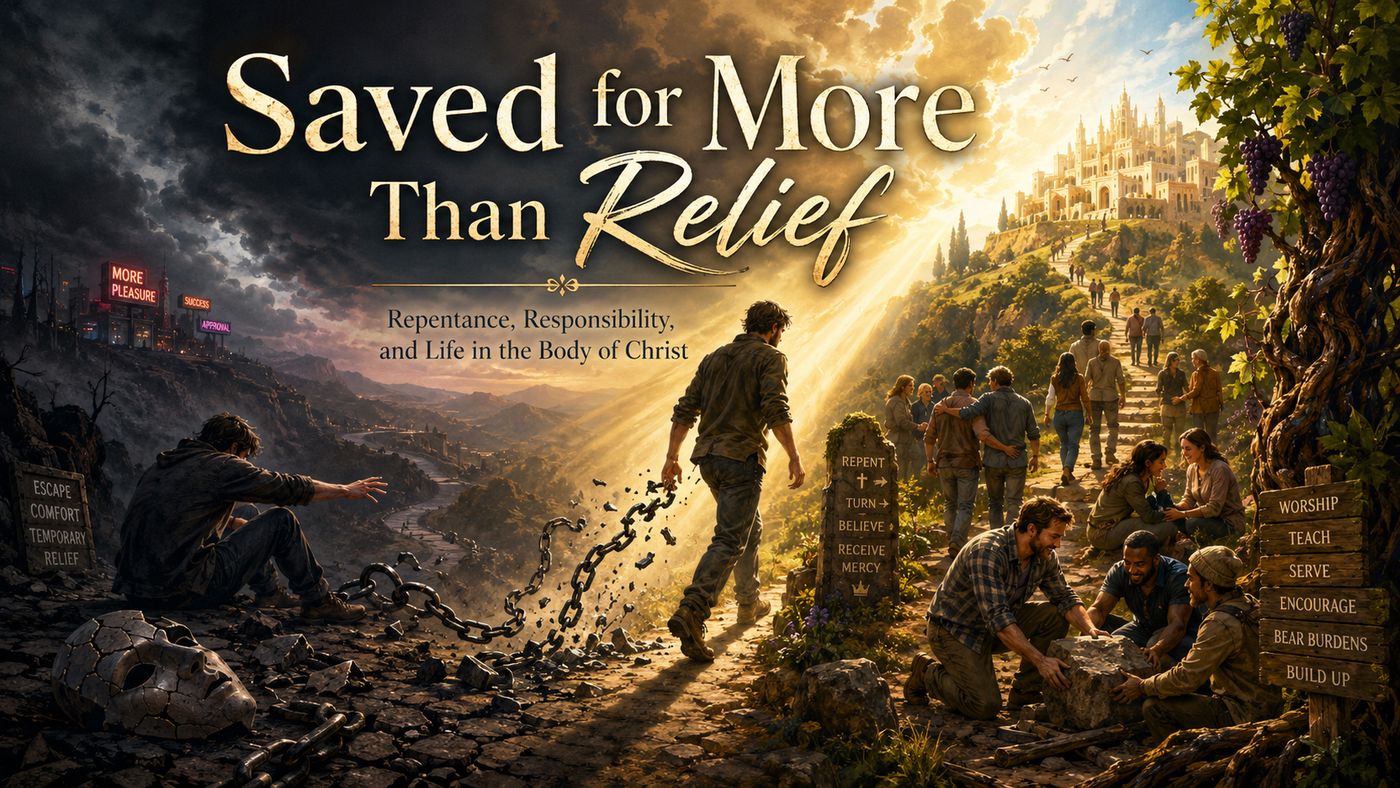
There is a kind of Christianity that wants the pain of sin removed without wanting the rule of sin broken.
It wants peace, but not surrender. It wants stability, but not holiness. It wants forgiveness, but not lordship. It wants the consequences of sin to quiet down so life can feel manageable again. And because that desire can sometimes produce visible change, we can easily mistake it for repentance.
But relief is not repentance.
Relief asks, “How can I get out from under the pain of what my sin has caused?”
Repentance asks, “How can I turn from the sin that has dishonored God?”
That difference may seem small at first, but it is the difference between a heart trying to preserve itself and a heart being brought low before the Lord.
The natural heart is very capable of seeking relief. It can want a marriage repaired because loneliness is painful. It can want addiction managed because consequences are frightening. It can want anger controlled because relationships are being lost. It can want reputation restored because shame is unbearable. It can want to “do better” because life has become too heavy to keep living the same way.
None of that is meaningless. Sometimes consequences really do wake people up to the danger of sin. Sometimes pain becomes the mercy that forces a person to stop pretending. But Scripture teaches us not to confuse the desire for relief with the grace of repentance.
A person can want good things for self-serving reasons. A person can choose better behavior because better behavior protects the self. Even compassion can become a way of preserving image. Even generosity can become self-justification. Even church attendance can become a form of religious respectability. Even theology can become part of a self-built kingdom if the heart is still refusing to bow before Christ.
This is why we have to ask a deeper question than, “Did they make a better choice?”
We have to ask, “What master did that choice serve?”
Jesus says, “Everyone who commits sin is a slave of sin” (John 8:34). That is not sentimental language. It is bondage language. He does not describe fallen man as spiritually neutral, standing between sin and righteousness with equal love for both. He describes man as enslaved. Paul says the same in Romans 6. Before grace, we were slaves of sin. We were not free people occasionally making unfortunate decisions. We were servants of a master.
That does not mean people do not make real choices. They do. Sinners choose. They reason. They prefer. They act. They pursue. They avoid. They love and hate. They build and destroy. The will is active.
But the will is not neutral.
The sinner chooses according to the heart that rules him. The slave of sin may choose morality when morality serves comfort. He may choose kindness when kindness protects reputation. He may choose discipline when discipline preserves control. He may choose religious language when religious language helps him regain trust. He may even choose outward obedience when outward obedience gives him relief from consequences.
But none of that proves that he has been made new.
The Westminster Confession is helpful here because it refuses to flatten the issue. It acknowledges that unregenerate people can do things that are, outwardly considered, commanded by God and useful to themselves and others. In plain language, lost people can do things that appear good and may even benefit people around them. But the Confession also says those works still do not please God spiritually because they do not come from a heart purified by faith, they are not done in the right manner according to the Word, and they are not done to the right end, the glory of God.
That is the missing piece.
The question is not only whether the action looks good. The question is whether the heart has been purified by faith and whether the aim is the glory of God.
This is where many people deceive themselves. They assume that wanting a better life means they want Christ. They assume that wanting consequences removed means they hate sin. They assume that wanting peace means they have repented. But worldly sorrow can hate the damage sin caused while still loving the sin itself.
Paul makes that distinction in 2 Corinthians 7:10: “For godly grief produces a repentance that leads to salvation without regret, but worldly grief produces death.”
Worldly grief can cry. Worldly grief can apologize. Worldly grief can make promises. Worldly grief can feel deeply ashamed. Worldly grief can say, “I never want to do that again,” while still being centered on self. It grieves the exposure, the embarrassment, the loss, the consequences, and the pain. But it does not yet grieve sin as rebellion against God.
Godly grief is different. Godly grief sees sin in the presence of God. It does not merely say, “I have ruined my life.” It says with David, “Against You, You alone, I have sinned and done this evil in Your sight” (Psalm 51:4). It understands that every horizontal wound has a vertical offense beneath it. Sin may damage relationships, but first it dishonors God.
That is why repentance is more than behavior repair.
Repentance is not merely choosing a cleaner life. It is not merely choosing a calmer home. It is not merely choosing to stop the bleeding. True repentance turns from sin to God. It sees sin as hateful, not merely inconvenient. It sees mercy in Christ as precious, not merely useful. It wants forgiveness, but it also wants freedom. It wants the Lord Himself, not merely the removal of pain.
And this is why the gospel must be presented truthfully.
We do not tell sinners, “Try to become religious enough to make God receive you.” We do not tell them, “Clean yourself up first.” We do not pretend that they can manufacture new life from an old heart. But neither do we soften the call of God. The sinner is commanded to repent. He is commanded to believe. He is commanded to come to Christ. He is commanded to seek the Lord while He may be found.
So what do we say?
We say, “Go to the cross. Plead for mercy. Stop hiding. Stop bargaining. Stop asking only for relief from consequences. You need more than a repaired life. You need a resurrected heart.”
This is where the language of seeking can be useful, if we understand it rightly. A sinner seeking mercy is not saving himself by seeking. He is not earning grace by appearing desperate enough. He is doing the only sane thing a condemned sinner can do: he is coming empty-handed to the only Savior who can give life.
The tax collector in Luke 18 did not stand before God with a record of improvement. He would not even lift his eyes to heaven. He beat his chest and said, “God, have mercy on me, a sinner.” Jesus says that man went home justified.
That is the posture.
Not image management.
Not consequence control.
Not temporary reform.
Mercy.
The sinner’s hope is not that he can finally turn relief into repentance by sheer force of will. The sinner’s hope is that God gives what He commands. God can take out the heart of stone and give a heart of flesh. God can grant repentance. God can open blind eyes. God can make Christ beautiful to a heart that once only wanted escape.
So the call is honest and urgent:
Choose repentance over relief, and beg God for the mercy of a heart that can truly desire it.
Do not settle for wanting the pain to stop. Do not settle for being a better version of the old self. Do not settle for religious language that leaves the old master undisturbed. Go to Christ. Plead for mercy. Ask Him not merely to change your situation, but to change you.
Because Christ does not save sinners so they can return to self-rule with fewer consequences.
He saves slaves.
And if the Son sets you free, you really will be free.
Mercy Gives What the Command Requires
The call to repent is not weakened by the sinner’s inability. Scripture does not look at the slavery of the human heart and say, “Since man is bound, God must lower the command.” Nor does Scripture flatter the sinner by pretending he can produce spiritual life from within himself. The Bible does something much more humbling. It commands sinners to repent, and then it teaches us that repentance itself must be granted by God.
That is where our pride begins to feel exposed.
We would rather believe that repentance is simply the better choice we finally decided to make. We would rather imagine ourselves standing above sin and Christ, calmly weighing our options, then choosing rightly because we were wiser, humbler, or more spiritually reasonable than others. But Scripture will not let us keep that story.
Jesus says, “No one can come to Me unless the Father who sent Me draws him” (John 6:44). Paul tells Timothy to correct opponents with gentleness, “instructing his opponents with gentleness. Perhaps God will grant them repentance leading them to the knowledge of the truth” (2 Timothy 2:25). When the Gentiles believed, the church did not say, “They finally found the moral strength to repent.” They glorified God and said, “So God has granted repentance resulting in life even to the Gentiles” (Acts 11:18).
Repentance is commanded.
Repentance is necessary.
Repentance is real.
But repentance unto life is also mercy.
This is where the Westminster Confession is so helpful. It speaks of effectual calling as the gracious work of God by which He enlightens the mind, takes away the heart of stone, gives a heart of flesh, renews the will, and makes the sinner willing and able to answer His call. That phrase is precious: made willing by grace.
God does not save a sinner by pretending the will was never enslaved. He saves by freeing the will from its bondage. He does not drag men to Christ against the deepest desire of their hearts. He changes the heart so that Christ becomes desirable. He does not merely put a new option in front of the old self. He gives life where there was death.
That is why repentance is not the old heart trying to behave better. Repentance is the first movement of a heart God is making new.
Ezekiel 36 gives us the promise beneath all of this: “I will give you a new heart and put a new spirit within you; I will remove your heart of stone and give you a heart of flesh.” Then God says, “I will place My Spirit within you and cause you to follow My statutes and carefully observe My ordinances.”
Notice the order.
God gives the heart. God gives the Spirit. God causes the walk.
That does not make repentance less real. It makes repentance possible. The person truly turns. The person truly grieves. The person truly believes. The person truly comes to Christ. But underneath every true movement toward God is the mercy of God moving first.
This protects us from two deadly errors.
The first error is passivity. Someone may hear that repentance is granted by God and wrongly conclude, “Then I will do nothing until God does something.” But Scripture never speaks that way. The sinner is not invited to sit back in spiritual laziness. He is commanded to come. He is commanded to repent. He is commanded to believe the gospel. He is commanded to seek the Lord while He may be found.
So we say to the sinner, “Go to Christ. Do not delay. Do not hide behind theology. Do not use inability as an excuse to remain in sin. Go to the cross and plead for mercy.”
The second error is self-salvation. Someone may hear the command to repent and imagine that repentance is a work by which he makes himself acceptable to God. But Westminster is careful here too. Repentance is not to be rested in as any satisfaction for sin. In plain language, repentance does not pay for your sin. Repentance does not earn your forgiveness. Repentance does not become the price you hand to God so He will finally show mercy.
Christ alone is the Savior.
Christ alone satisfies divine justice.
Christ alone bears the curse.
Christ alone cleanses the sinner.
Repentance is not the payment for mercy. It is the fruit of mercy.
That means the gospel call is both urgent and humble. We do not tell sinners, “Clean yourself up and then come to Christ.” We say, “Come to Christ because you cannot clean yourself.” We do not say, “Make your heart new and then repent.” We say, “Go to the only One who can give a new heart. Plead for mercy. Ask God to grant what He commands.”
This is why the prayer of the tax collector in Luke 18 is so beautiful. He does not come with a polished record. He does not come with a strategy for self-improvement. He does not come explaining why he is not as bad as others. He stands far off, will not even lift his eyes to heaven, beats his chest, and says, “God, turn Your wrath from me—a sinner!”
Jesus says that man went home justified.
That is not relief dressed up in religious language. That is a sinner with empty hands crying for mercy.
True repentance begins there. It stops defending. It stops comparing. It stops managing appearances. It stops bargaining with consequences. It stops saying, “At least I am not like them.” It comes into the light and says, “Lord, I have sinned. I need mercy. I need cleansing. I need You.”
The Westminster Confession describes repentance unto life as an evangelical grace. That simply means repentance belongs to the good news of grace. It is not merely terror. It is not merely shame. It is not merely fear of hell. It is not merely sorrow over broken relationships or ruined comfort. True repentance sees not only the danger of sin, but also the filthiness and hatefulness of sin. It sees sin as offensive to God. It grieves over it. It hates it. It turns from it to God. And it does this while laying hold of mercy in Christ.
That last part matters.
Repentance without mercy becomes despair.
Mercy without repentance becomes presumption.
But true repentance sees both: the horror of sin and the hope of Christ.
This is where relief and repentance part ways again. Relief wants mercy only as escape. Repentance wants mercy as reconciliation. Relief wants God to make life feel safe again. Repentance wants God Himself. Relief asks God to remove the consequences while leaving the old loves untouched. Repentance asks God to crucify the old loves because Christ has become better.
And once God gives that kind of heart, something begins to change.
The Christian no longer sees repentance merely as punishment. Repentance becomes a gift. Painful, yes. Humbling, yes. Often costly, yes. But still a gift. It is the way the Father brings His child out of hiding. It is the way the Shepherd restores the wandering sheep. It is the way the Spirit keeps pressing the life of Christ into places we once protected from the light.
This does not mean the believer repents perfectly. It does not mean the Christian never resists conviction, never fears exposure, never struggles with pride, never confuses relief with repentance again. Sanctification is not instant maturity. But something real has changed. The believer now has a new Master, a new heart, a new direction, and a new ability to love God.
Before grace, the sinner may run from consequences while still loving sin.
After grace, the believer can begin to run from sin because he has been brought to love Christ.
That is the miracle.
The old heart says, “How can I get out of this pain?”
The new heart begins to say, “How can I be made more faithful to the Lord who saved me?”
The old heart wants enough change to survive.
The new heart wants Christ to rule.
The old heart seeks relief because it is trying to preserve itself.
The new heart learns repentance because it has already been claimed by mercy.
And this is why repentance cannot be the end of the Christian life. If God has granted repentance, He has not merely rescued us from consequences. He has brought us under the lordship of Christ. He has joined us to Himself. He has placed us among His people. He has given gifts, obligations, affections, and callings. The heart that once sought only relief is now being trained to ask a better question:
“Lord, now that I belong to You, how do You intend to use me for the good of Your body and the glory of Your name?”
Repentance Grows Into Responsibility
When God grants repentance, He does not merely rescue a sinner from consequences. He brings that sinner under the lordship of Christ and into the life of Christ’s body.
This is where many people stop too soon.
They think salvation is only about being forgiven. They think repentance is only about turning from whatever sin created the crisis. They think church membership is the finish line, as though joining a congregation is the same thing as functioning as a living member of the body.
But Scripture gives us a much fuller picture.
Christ does not save people into isolated, self-managed spirituality. He saves them into a people. He joins them to Himself, and because they are joined to Him, they are joined to one another. The Christian life is personal, but it is never private. The same grace that brings us to repentance also brings us into responsibility.
Paul says in Romans 12, “Now as we have many parts in one body, and all the parts do not have the same function, in the same way we who are many are one body in Christ and individually members of one another.” That last phrase is easy to pass over, but it is weighty: members of one another.
The Christian does not merely attend near other Christians. He belongs to them in Christ.
That does not mean the church owns him in some abusive or controlling sense. It means Christ has designed His people so that no member matures alone, suffers alone, serves alone, or exists for himself alone. The hand is not an independent hand. The eye is not an isolated eye. The foot does not get to decide it has no obligation to the body because it prefers a quieter life.
In 1 Corinthians 12, Paul presses this even further. The body is one, but it has many parts. The parts are different, but they are not disposable. The weaker members matter. The less visible members matter. The honored and less honored members belong together. No part can say, “I do not need you.” No part can say, “Because I am not like that part, I do not belong.”
That means responsibility is not reserved for a special class of Christians.
Every believer has a place. Every believer has gifts. Every believer has duties. Every believer has a role in the mutual building up of the body.
This is why the Westminster Confession’s chapter on the communion of saints is so important. It teaches that believers, being united to Christ, also have fellowship with one another in Him. They are bound to maintain holy fellowship and to use their gifts and graces for the mutual good of one another. In plain language, if Christ has given grace to you, He did not give it for you to bury. He gave it so the body would be strengthened.
Grace makes us responsible.
Not responsible in a crushing way, as though the whole church depends on our strength. Not responsible in a prideful way, as though God needs us to accomplish His purposes. But responsible in the biblical sense: entrusted, obligated, placed, gifted, and called.
The question is no longer merely, “How do I get relief from the consequences of my sin?”
The question becomes, “Now that Christ has shown me mercy, how do I live for His glory and the good of His people?”
That is a different kind of question because it comes from a different kind of heart.
The lost heart asks, “How can I survive this?”
The repentant heart begins to ask, “How can I obey Christ here?”
The maturing heart learns to ask, “How can my life help build up the body?”
That movement from relief to repentance to responsibility is one of the marks of grace. The believer is no longer content merely to escape pain. He wants to become useful. He wants his life to strengthen others. He wants his repentance to bear fruit. He wants his gifts, wounds, lessons, failures, and victories to become instruments in the hands of Christ.
Ephesians 4 gives us the shape of this. Christ gives leaders to equip the saints for the work of ministry, to build up the body of Christ, until the body grows into maturity. The work of ministry is not handed only to pastors while everyone else watches. Pastors and teachers equip the saints so the saints can do the work of ministry. The whole body grows as each part works properly.
That phrase matters: each part.
Not a few visible parts.
Not only the unusually gifted parts.
Not only the confident parts.
Not only the mature parts.
Each part.
A church full of spectators may gather in the same room, but it is not functioning as a healthy body. A church full of attenders may have activity, but that does not mean it has maturity. A church full of members on paper may still have many people who have not learned what it means to belong to one another in Christ.
This is one of the heavy burdens of pastoral ministry. There is joy in discipling new believers who are full of zeal, hunger, and fresh wonder. There is also joy in shepherding mature Christians who are steady, faithful, teachable, and fruitful. But there is often a large middle that is much harder to shepherd.
Some in that middle may be unconverted, though they wear the name of Christian and member. They have learned the language, habits, and rhythms of church life, but their lives still show no clear evidence of repentance, new birth, or love for Christ. Others may be true believers, but they have become complacent. They assume that membership is the end of obedience rather than the beginning of responsibility. They attend, agree, and receive, but they do not yet function as active members of the body.
This must be said carefully. We are not God. We do not see hearts perfectly. We must not become harsh, suspicious, or eager to pronounce judgment where Christ has not given us authority to do so. Weak believers exist. Wounded believers exist. Immature believers exist. Some sheep limp for a long time and need patient care.
But carefulness must not become cowardice.
The New Testament does not allow us to treat passive church attendance as the goal of Christian maturity. Hebrews 10 tells believers not only to gather, but to watch over one another in order to provoke love and good works. Galatians 6 tells spiritual believers to restore the one caught in sin with gentleness. Romans 15 says the strong have an obligation to bear with the weaknesses of the weak and not to please themselves. First Peter 4 says each one should use whatever gift he has received to serve others as a good steward of God’s varied grace.
That means mature Christians cannot simply enjoy being mature.
They are responsible to help others grow.
A mature believer is not someone who has graduated from needing the body. A mature believer is someone who has learned how to strengthen the body. Maturity does not make us less obligated to others. It makes us more aware of the obligation.
This is where responsibility becomes deeply practical.
The older men and women must help the younger. The steady must help the wavering. The restored must help the fallen. The taught must teach. The comforted must comfort. The forgiven must forgive. The strengthened must strengthen. The humbled must walk gently with the proud. The mature must call the complacent out of mere attendance and into living usefulness.
Not everyone will do this from a platform. Most will not.
Some responsibility looks like teaching a class. Some looks like discipling one younger believer over coffee. Some looks like showing up early and staying late. Some looks like noticing who is drifting. Some looks like praying with the discouraged. Some looks like quietly bearing burdens no one else sees. Some looks like opening a home. Some looks like speaking a hard word gently. Some looks like refusing gossip. Some looks like serving children, widows, the disabled, the lonely, or the overlooked. Some looks like simply being faithful for decades until others learn what faithfulness looks like by watching.
The body needs all of that.
And this is where we must be careful with fruit. We cannot always measure faithfulness by visible results. Some people sow for years before seeing anything grow. Some serve in hidden ways. Some speak truth and are rejected. Some pray faithfully and never know what God did through those prayers. So visible fruit cannot become a scoreboard for pride or despair.
But a Christian life should not remain a spiritual dead end.
If grace is maturing us, then over time our presence should increasingly build up rather than drain the body. People around us should be helped toward faithfulness, not constantly pulled into our chaos. Our repentance should make us safer to correct, easier to walk with, quicker to serve, slower to demand, and more eager to strengthen others. Our theology should become more than language. It should become humility, usefulness, courage, and love.
This is the difference between a person who only wants relief and a person being trained by grace.
Relief wants enough change to make life manageable.
Repentance turns from sin to God.
Responsibility says, “My life is no longer my own. Christ has joined me to His body, and I must not bury what He has entrusted to me.”
This does not happen all at once. Sanctification is a journey. The believer still battles fear, pride, selfishness, laziness, insecurity, and the old desire to retreat into himself. But now he battles as someone who belongs to Christ. He does not need to hide from the body. He needs to find his place in it.
The Christian was never meant to live like an isolated individual trying to become like God. That was part of the old lie. From the beginning, sin curved man inward. It made the self the center. It made autonomy feel like freedom. But Christ restores what sin destroyed. He brings us back under God, and He brings us back into communion.
We are not saved into self-rule.
We are saved into lordship.
We are not saved into isolation.
We are saved into a body.
We are not saved merely to escape consequences.
We are saved to glorify God, serve His people, and bear fruit that outlives us.
So the question for the Christian is not merely, “Am I a member of a church?”
The question is, “Am I functioning as a member of the body?”
Am I using what God has given me for the good of others? Am I helping anyone grow in faithfulness? Am I being equipped, and am I helping equip others? Am I known enough to be corrected? Am I humble enough to receive care? Am I mature enough to give care? Am I only attending, or am I actually belonging?
These questions are not meant to crush the weak. They are meant to wake the sleeping.
Christ does not call His people out of relief and into repentance so they can sit still in spiritual comfort. He calls them into a life of grateful obedience. He makes them alive, joins them to His people, and teaches them to become useful in His hands.
Grace does not merely pardon.
Grace trains.
Grace joins.
Grace equips.
Grace sends.
And where repentance is real, responsibility will eventually begin to grow.
-Justin Reed
Brushwood Press